
What's at stake?
A biological stepping stone in the Eastern Tropical Pacific corridor between the Galápagos, Coco Island and Revillagigedo, Gorgona is one of Colombia’s most biodiverse marine zones and also one of its least observed. Past civil unrest left biodiversity records fluctuating and incomplete, making this stretch of the Coastal Pacific a true data desert waiting to be filled.
Communities involved
Guapi fisherwomen and fishermen, with local schools joining and receiving species booklets.
About our site
From 1960 to 1984, Gorgona was a maximum-security prison, an island so remote that its currents and sharks were considered escape enough. When the prison closed in 1984, the island was returned to nature and became a national park.
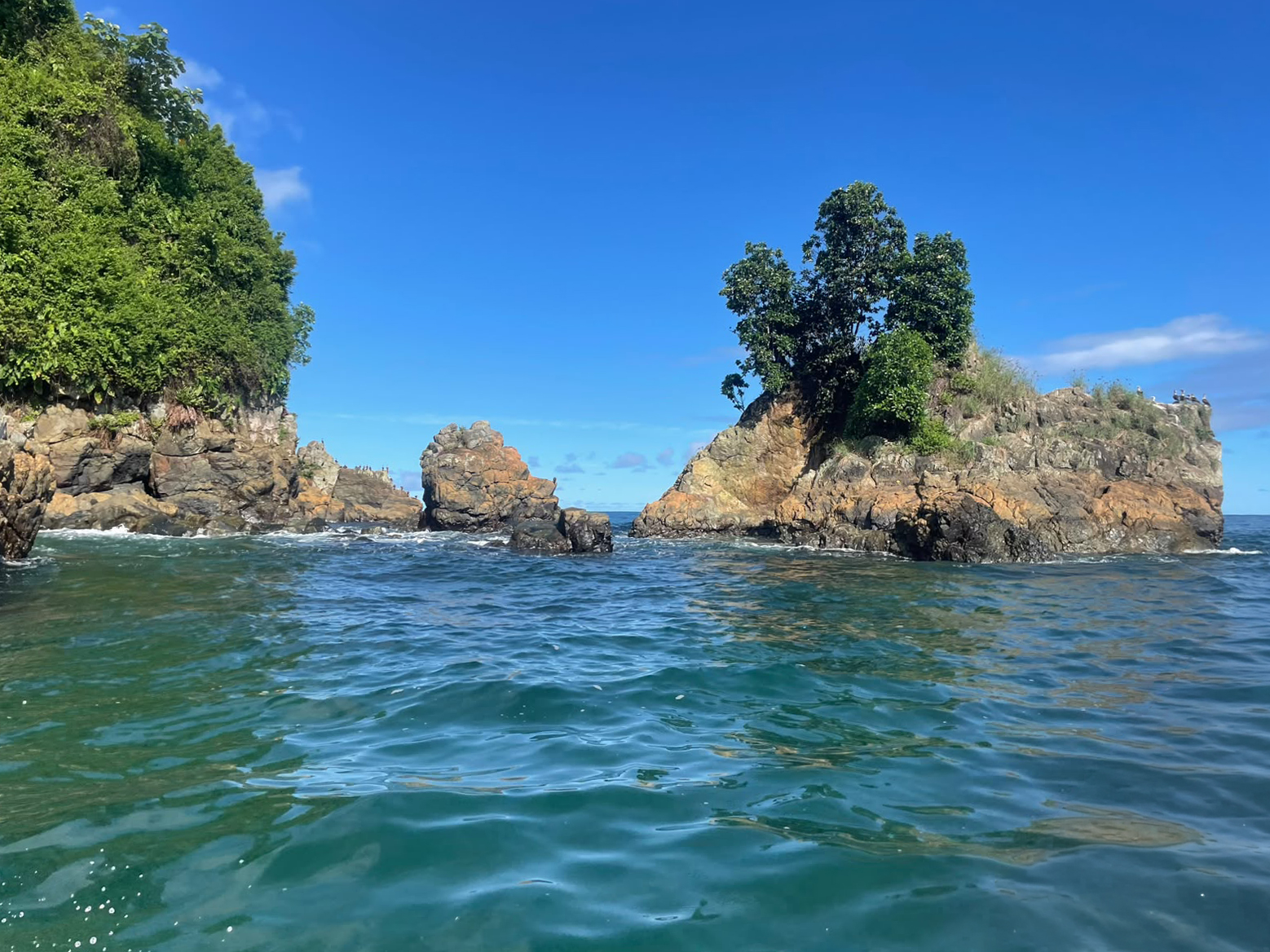
Today it is an almost pristine, uninhabited island in the Colombian Pacific, about 9 kilometres long and 3 kilometres wide, forested and surrounded by open ocean, an hour and a half to two hours by boat from the coast at Guapi. It is also a UNESCO-protected area, and the waters around it form a marine protected area.
The park matters because it sits as an intermediate island in the Eastern Tropical Pacific corridor, the most coastal of a chain that links the Galapagos, Coco Island, Malpelo and Revillagigedo. That position brings a high presence of whales and dolphins, and many sharks, including smaller endangered species. Whales can be seen in front of the island throughout the year, and especially during the mating season.
The Colombian Pacific has long been isolated and little studied, so even in such a diverse and productive region, its marine biodiversity remains poorly known. That isolation also distanced people from the island: many on the mainland, including schoolchildren, have never been to Gorgona and do not feel it belongs to them. Rebuilding that relationship, what we call social appropriation, is central to the work here.
“Protecting biodiversity at Gorgona will have an impact on species up to the Galapagos, the Coco Islands and beyond.”
What we plan to achieve
Through eDNA Expeditions, we will produce the first community-driven, DNA-derived biodiversity dataset in Colombia. INVEMAR, which leads the project, hosts the OBIS Colombia node, and we will mobilize new data every three months, with a dedicated team member working full time to make it openly available.
Environmental DNA is especially suited to Gorgona. Rough seas, counter-currents and the cost of access make traditional monitoring irregular, and in some years it does not happen at all. With eDNA, a team can take a water sample and leave, covering both the sheltered and the exposed sides of the island without putting researchers at risk, and still gather reliable, comparable data.
Our aim is to inform decisions, not only to produce a species list. Gorgona is one of the few marine protected areas in Colombia with disciplined annual monitoring, and its managing authority, National Parks, updates its management plan every four years. The data will help them sharpen those plans, focus on vulnerable areas, and track endangered or invasive species. We will sponsor three years of monitoring, with the goal that eDNA becomes a permanent part of the park’s toolkit afterwards.
The project is also about people. We work with the fisherwomen and fishermen of Guapi and, above all, with children, returning the results as illustrated booklets that live in local schools, so the next generation knows what lives in their own ocean. We will also share the technology with universities, the research institute IIAP and local NGOs, so that many more can put it to use.